Dead Wipers, Silent Socket, No Interior Light? Read the Fuse Map First
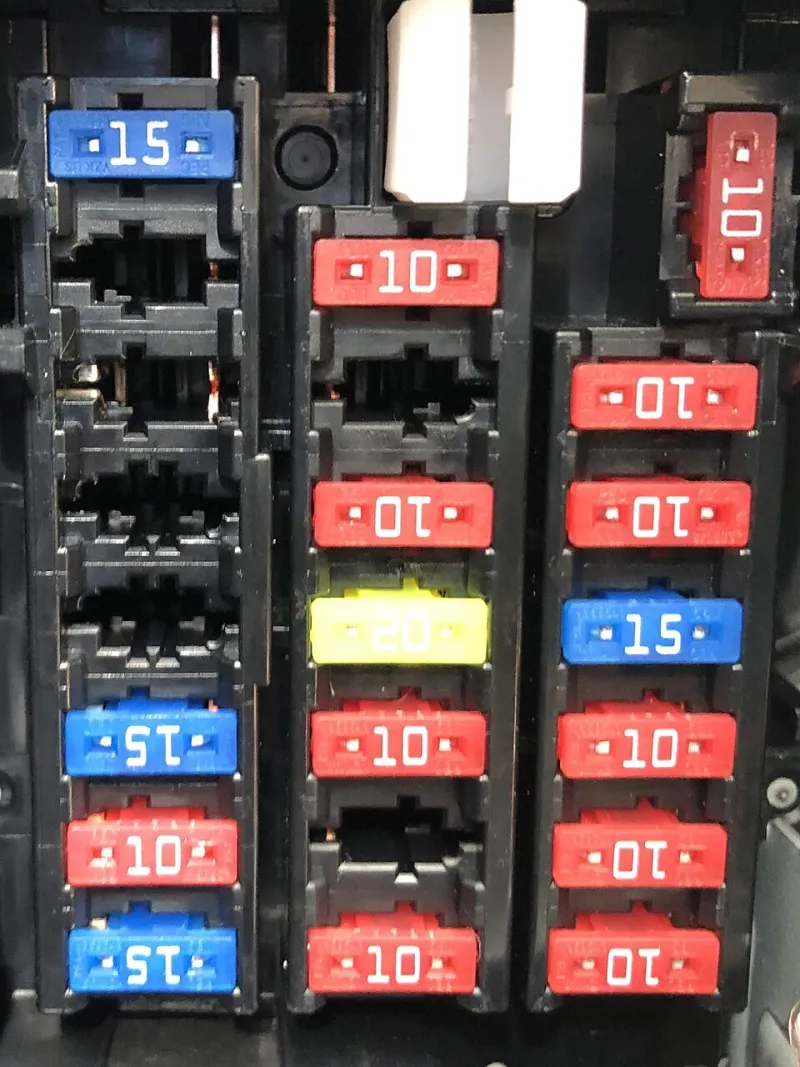
Photo: project Kei, CC BY-SA 4.0, via Wikimedia Commons
It always happens at an inconvenient moment. The wipers quit halfway through a squall on the M6, the 12V socket stops charging your phone on the morning the sat-nav dies, or the interior lights give up in the week the clocks change. Nine times out of ten, none of it is serious. A blade fuse the size of a postage stamp has done its job: it gave up so that a length of wiring didn't.
What follows is the calm version of the roadside panic.
Find the map before you need it
Every car has at least one fuse box, often two or three. The usual suspects are under the dashboard near the driver's knee, in the engine bay behind a plastic cover, and occasionally in the boot behind a trim panel. The lid of each box normally carries a diagram listing what each fuse protects; if it doesn't, your handbook will.
Take a photograph of every diagram now, while it's dry and light and you're not in a hurry. Save them to an album called something you'll actually remember. This takes two minutes and is the single most useful thing in this article.
Blade fuses, briefly
UK cars overwhelmingly use blade fuses: a coloured plastic body with two metal prongs. They come in four physical sizes — standard, mini, micro2 and maxi — and most modern cars use mini or micro2 inside the cabin. The colour is the rating, and the colour code is worth learning:
- 5A tan
- 7.5A brown
- 10A red
- 15A blue
- 20A yellow
- 25A clear
- 30A green
An assortment box covering your car's sizes costs about the price of a coffee and a sandwich, and it lives in the car permanently. Buy one that matches the sizes you actually found when you checked the box.
Testing one properly
Start with your eyes. Hold the fuse up to the light and look at the element inside. A healthy fuse shows a continuous strip of metal; a blown one has a gap, sometimes with a smear of black on the plastic. Be warned that a fuse can look perfectly fine and still be broken right at the base of a blade, so don't stop there.
The quick roadside method is a test light or a multimeter. With the fuse in place and the ignition on, touch the probe to the two small exposed test points on top of the fuse. Both live means the fuse is fine. One live and one dead means it has blown. That's it — no removal required.
Alternatively, pull the fuse with the plastic puller clipped inside the fuse box lid, or with your fingers if there's room, and check continuity across the two blades. Never lever one out with pliers; you'll crack the plastic and skin your knuckles.
The one rule you don't break
Fit the same rating. Not one step up. Not a bigger fuse borrowed from a slot that looks less important. Not foil, not wire, not a wrapped-around paperclip.
A fuse is deliberately the weakest point in a circuit. The wiring, connectors and terminals behind it are chosen to carry a specific current. Fit a 20A fuse where a 10A belongs and you haven't fixed anything — you've simply moved the weakest point into the loom. That's how you turn a £1 part into a melted wiring harness, a dead module or, at the more serious end, a fire.
This matters most with accessories. A cheap 12V charger or a coin dropped into the socket will pop the same fuse repeatedly, and the temptation is to fit something heavier so it stops happening. Don't. Find the accessory that's causing it instead.
When a blown fuse is a symptom, not the fault
A fuse that blows once, after a known event such as a socket mishap or a jump start, is usually just a fuse. A fuse that blows again the instant you switch the circuit on is telling you something is shorted: a chafed wire, water in a connector, a seized wiper linkage, a failing motor, or damp in a lamp housing.
Stop at that point. Replacing a fuse repeatedly doesn't diagnose anything, and each attempt pushes current through a fault. Two failures on the same circuit means it's a garage job — and it's worth saying so on the phone, because it tells them you've done the obvious.
It's also worth knowing that not every dead component is a fuse. Wipers can fail at the linkage or the motor. Interior lights can be a door microswitch or the switch itself. A dead 12V socket can be the socket, not the fuse. The fuse is simply the cheapest thing to check first.
The five slots worth knowing
Most handbooks list dozens of circuits, but a handful cover the faults that actually strand people or irritate them daily: the 12V socket, the wipers, the washers, the horn, and the interior lights. Some cars share one fuse across several of those, which explains why one small failure seems to take three things with it.
Make a note of those slots — number and rating — in your phone. Next time the socket dies, you'll go straight to the right blade instead of pulling twenty at random and losing the diagram in the footwell.
Keep the fuses dry, keep a puller in the car, and keep the photograph of the diagram where you can find it. Ten minutes of preparation, and the smallest part in the car stops being the most intimidating.